Atlas Underground
Time lapse video of the construction of the Atlas experiment at CERN. The underground particle accelerator will be the largest ever constructed, and perhaps the most complex experiment in the history of science.

Time lapse video of the construction of the Atlas experiment at CERN. The underground particle accelerator will be the largest ever constructed, and perhaps the most complex experiment in the history of science.
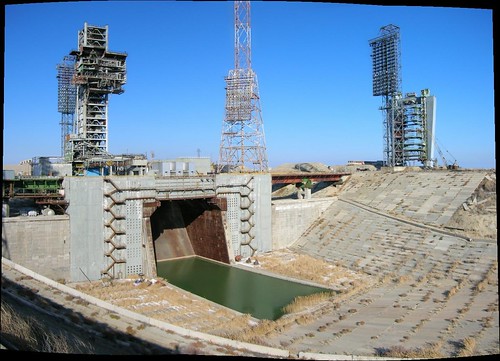
In the vast and dry nation of Kazakhstan the Baikonur Cosmodrome remains an operational testament to the Space Race. Baikonur is the world's oldest and largest operational space launch facility. After the collapse of the Soviet Union in 1991 it continued operation in partnership with the Commonwealth of Independent States.
The Baikonur Cosmodrome is home to a tremendous amount of space exploration history. The first human spaceflight (Vostok 1) launched here as well as the first unmanned satellite (Sputnik 1). The facility was crutial for the International Space Station construction after the 2003 Columbia disaster.
Now, like so much else, the old Cosmodrome is a tourist attraction. RusAdventures offers a six day tour that departs from Moscow with your choice of English, French or German tour gides.
Good non-fiction answers a question you hadn't thought to ask. I had not realized how difficult it was to measure longitude. This short book details the scientific and political struggle of John Harrison, a British clockmaker. Although a volume of this size or much greater could explain the intricacies of clock mechanisms, this volume doesn't particularily do that. It does show how Harrison had to fight the entrenched scientific idea that longitude could only be found using astronomy.
Indeed, before Harrison, that was the case. On land longitude was measured using telescopic readings of Jupiter's moons. At sea, however, telescopes couldn't hold an image long enough to be accurate. Harrison's clocks attempted to measure the difference between a ship's port time and the local time. This works because one hour of longitude is actually one twenty-fourth of the earth's daily rotation. Before Harrison, nobody had built a clock sturdy or accurate enough to use for navigation.
British Parliment came up with the Longitude Act, a sort of early request for proposals, that would reward the winner with a large cash prize and fame. The prevailing academic notion was that the Moon's cycles could be used to cipher longitude. This was pushed by Isaac Newton, and a host of other astronomers who thought mechanical solutions were too fragile. But the moon is not visible behind clouds, during the day, and when it's obscured by the earth. Furthermore, the moon-method required at least 45 minutes of calculation by a ship's navigator.
Despite the political pressure not to use mechanical clocks for navigation, Harrison's worst enemy was his own perfectionism. His dealings with the Board of Longitude (the people in charge of awarding the prize) were tumultous largely because of how he dispariaged his own craftsmanship. Regardless, the H-4 (also known as The Watch) was a masterpiece of timekeeping that demonstrated extreme precision and ease-of-use.
*Cross Posted from A Single Step*
Architects, designers, planners and all those associated professions often describe the "image" of the cities, neighborhoods, and regions. The overwhelmingly visual nature of place-based discussion crowds out other sensory experiences. The architectural demands for aesthetic appeal would seem to leave no room for acoustic experiences. Nevertheless, the fields of sound design and acoustic ecology exist on the outer edges of urbanism and architecture.
Aside from the science and technology surrounding opera halls and recording studios little is understood about how sounds interact with physical spaces. A few intrepid recorders have put their soundscape samples online. The largest collection of natural sounds (mostly animals) is Cornell's Macaulay Library. (I can't get this to work on my work computer, but perhaps you can!) SoundTransit provides a way to listen to a trip around the world. Dozens of other websites also provide recordings (scroll to soundwalks and soundmarks)
At least one architect embraces the role of sound. "Using lasers, heart monitors and other technological gadgets, Christopher Janney explores the nature of creativity and the origin of the soul." (Listen to the article at NPR, ~5 min.) Adding sound-features to buildings could have significant benefits for the blind, too. The technology to process visual images into patterns of sound are already available. It would certainly be an interesting treat if the design and planning community could get out of its visual-cortex and mold spaces around different methods of sensation.
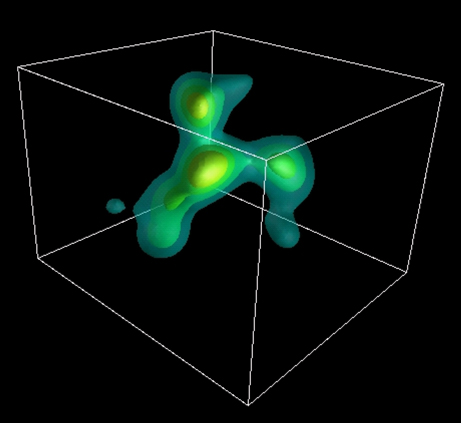
Astronomers call it "the blob" or "giant blob" and it is the most massive thing in the universe known to man.
You have never really seen "the blob," it is too dim for the naked human eye. Even so, it's not much worth looking at. You would think that a galaxy cluster over 200 light years in width would be pretty remarkable, right? Well it is, but not for its looks. "The Blob" is one of the oldest structures in the universe, it formed 12.7 billion years ago. Astronomers also speculate that this cluster is something like a nursery for whole galaxies.
Previously known structures with such high density are much smaller, only about 50 million light-years across. "The densest regions in the universe are the places where galaxies are thought to have formed first. Because this is one of the biggest structures known, it must be one of the very first to have formed," said Philip Best, an astronomer at the Institute for Astronomy at the University of Edinburgh in the U.K.
In August Wired Magazine wrote about MIT's decision to develop clean, affordable sources of energy. I stumbled upon it while reasearching Emission-to-Biomass (E2B) technology, a process pioneered at MIT (more on E2B below...)
Wired outlines a bunch of what MIT is working on through the Energy Research Council:
Light comes in three basic flavors: red, green, and blue - or so I thought. The standard operating procedure for vision is that Humans (along with primates, and a few other critters) have visual color perception that allows us to distinguish approximately 100 different shades of each of the three colors of light. Mixing and blending these colors in combination allows us to see millions of distinct hues - we are natural trichromants.
However, there are some women who can see four basic wavelengths of light. From Damn Interesting: "In an odd twist of fate, the same genetic glitch that creates color-blind males may create females with better-than-usual color vision." A small percentage of women are capable of detecting a range of color that exists between in a "orange-ish" spectrum. It may be impossible for trichromats to imagine what the world looks like to a tetrachromant.
Genecists have been aware of this acute visual perception for years. According to the Wikipedia, "some birds, fish, amphibians, reptiles, arachnids and insects" are known tetras, and a butterflies might be able to see 5 full wavelengths of color, although their 4th wavelength is in the ultraviolet range, beyond the human eye's capabilities.
Detecting the necessary genes for an enhanced color perception is one thing, to actually demonstrate that tetrachromants can see a range of colors that is an order of magnitude greater than the majority is another issue. Mothers of color blind sons have been tested on their visual perception and speed in color-differentiation. Researchers believe that while many women might have the genetic coding to be tetrachromatic, only a few can detect the "colossal range ... 100s of millions of colors" (approx. 2-3% of women).